

Guide to U.S Shield Nickels
The Shield Nickel was introduced in 1866, representing the first five cent denomination struck in copper-nickel. Originally, the five cent pieces produced for circulation within the United States had been struck from silver and were referred to as half dimes. For several years, the new “nickels” circulated alongside the old half dimes, but eventually the nickel would become the sole representative of the denomination. Shield Nickels would be produced across two major design varieties until 1883 when the new Liberty Nickel design would be adopted.
The nickel denomination was born out of the need for small circulating coinage. In the years before, during, and immediately after the American Civil War, citizens hoarded silver, gold, and even copper coins for their intrinsic value. Various substitutes were used to fill the gap including encased postage stamps and fractional currency. After a scandal in which the head of the Currency Bureau put his own face on the five-cent note, other solutions were sought.
Legislation
On March 3, 1865 a bill was passed authorizing the production of the three cent piece with a composition of 75% copper and 25% nickel. After initial success with the denomination, United States Mint Director James Pollock recommended a five cent piece with the same metallic composition. The House of Representatives coinage subcommittee suggested a weight of 5 grams (77.19 grains), which was ultimately adopted. The bill was passed on May 16, 1866 without considerable debate and the new nickel five cent piece was authorized.
Several different designs options were explored, and a considerable number of patterns were created by the Mint’s Chief Engraver James Barton Longacre. Some interesting options included busts of George Washington and Abraham Lincoln on the obverse. However, ultimately the Treasury Secretary chose a simple design featuring a shield motif, which was similar to the design of the previously introduced two cent piece.
Obverse design
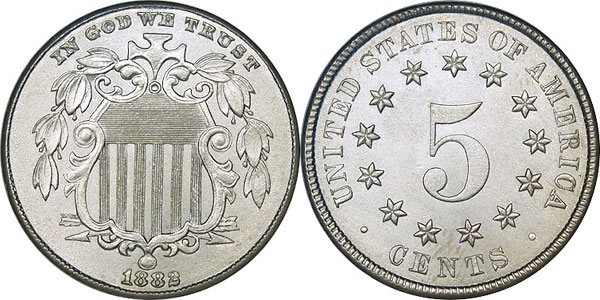
The obverse design of the Shield Nickel features a large shield with a cross at the top and laurel branches to the sides. The shield contains thirteen vertical stripes bound by an upper section of horizontal lines, representing the unity of the states leading to the strength in the federal government. A pair of crossed arrows are visible behind the base of the shield. The motto IN GOD WE TRUST appears above with the date below.
Reverse design
The reverse design features a large numeral “5” within a circle of 13 stars. The inscriptions UNITED STATES OF AMERICA and CENTS appear surrounding, separated by two dots. When the design was initially released, rays were placed between each of the stars. In production, these rays proved problematic since they required extra pressure to flow the metal into the recesses of the design, leading to more frequent die failure. The rays would be removed from the design in early 1867 to remedy the issue, although striking issues would still persist due to the hardness of the copper-nickel composition.